

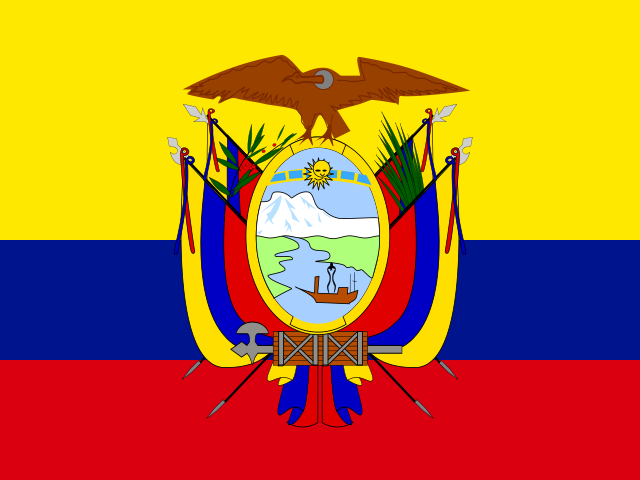
Recognizing who we are to transform: education and the pride of being Ecuadorian
Education strengthens Ecuadorian pride by helping young people understand, value and transform the country without losing their roots.
AULA ABIERTA
María Patricia Enríquez. Professor, UIDE School of Communication
9/1/20264 min read
September invites us to talk about Ecuadorian pride. It is a month to look again at what defines us, celebrate what we have built and recognize the immense richness of a country that, despite its size, contains an extraordinary diversity of territories, cultures, histories and ways of understanding the world. But perhaps it is also an opportunity to ask ourselves what it truly means to feel proud of a country and, above all, how we pass that sense of belonging on to new generations.
Pride should not be reduced to a flag, a date on the calendar or a list of symbols we learn as children. Nor does it mean believing that our country is perfect. A sense of belonging is built when we know the place we are part of, learn to value it and are able to recognize ourselves within it. In this process, education plays a fundamental role.
Learning is also about recognizing who we are
Educating for Ecuadorian pride does not mean teaching young people to idealize the country, but rather giving them the tools to know it, understand it, value it and recognize themselves as active participants in its transformation. That knowledge begins with our history, but it does not end there. It is also present in the literature we read, our music, artistic expressions, science, entrepreneurship, communities, family traditions, our cuisine and the different social realities that coexist within Ecuador.
Because there is no single way to be Ecuadorian. There are as many ways to live and express our identity as there are stories, territories and people in this country. The experience of someone who grew up in a large city is not the same as that of someone raised in a rural community. Nor are the memories, customs and ways of seeing the world found on the Coast, in the Andes, the Amazon or the Galápagos identical. Added to this are different peoples and nationalities, migration experiences, generations and family backgrounds.
“This diversity does not weaken our identity; on the contrary, it enriches it.”
That is why one of education’s greatest challenges is allowing young people to find themselves within what they learn. To discover that the country’s history also unfolded on the streets they walk every day; that their families’ customs form part of a broader collective memory; and that the accents, flavors, landscapes and expressions present in their daily lives also tell a story about who we are. Identity is not taught simply as a list of symbols to be memorized. It is discovered, recognized, shared and also built.
Young people who belong to a global world
This reflection becomes even more important at a time when we are educating generations that are deeply connected to the world. Our students access content produced thousands of kilometers away every day, interact with other cultures and participate instantly in global conversations. And that represents an enormous opportunity.
Preparing young Ecuadorians for the future means developing skills that allow them to navigate international environments, understand technological transformations, adapt to new professions and engage with people who think and live in different ways. But opening up to the world should not mean losing our roots.
On the contrary, a truly global education can teach us to engage with other realities from a strong sense of our own identity. We can learn from other societies, embrace new ideas, use new technologies and take part in the major conversations of our time without ceasing to ask what those transformations mean for our country and how they can help address our own challenges. A young person can feel deeply Ecuadorian and, at the same time, be a citizen of the world. These two identities do not contradict each other. They complement one another.
From pride to participation
There is also another dimension of pride that we rarely mention: responsibility. Feeling part of a community means understanding that what happens within it also concerns us. That is why educating young people to feel proud of their identity is not only about teaching them to value what Ecuador has been or what it is today.
It also means helping them imagine what it could become and recognize that they have a role in building that future. This is where education can make an enormous difference. Every profession offers a different way to contribute to the country. It may be the person who creates a company and generates employment; someone who researches a solution to a problem in their community; someone who teaches in a school; develops new technology; preserves our heritage; produces art; communicates responsibly; protects our ecosystems; or finds a different way to respond to a social need.
Transforming a country does not happen only in major decision-making spaces. It happens every day through thousands of individual and collective actions. That is why we need an education that, in addition to transmitting knowledge, awakens curiosity, strengthens critical thinking, promotes empathy and teaches people how to work with others. An education that enables students to understand the problems in their surroundings, while also recognizing the opportunities that exist to transform them.
The Ecuador we can still build
Talking about Ecuadorian Pride Month, then, is about much more than celebrating what makes us feel good about our country. It can also be an invitation to look at Ecuador with affection, curiosity and hope. To learn the stories of those who came before us and listen to those that, for a long time, were given less space. To discover our territories. To value our diversity. To recognize the talent that exists within our communities. And also to understand that our identity is not finished, because each generation adds new experiences and new ways of being Ecuadorian.
Perhaps this is one of education’s most beautiful tasks: helping young people understand that they, too, are part of this story. We cannot ask them to transform a country they feel no connection to. First, we must allow them to know it, find themselves within it and discover reasons to value it. Then will come the questions, ideas, projects and new ways of building it. Because education should not only mean preparing our young people to find their place in the world. It should also help them discover what their place might be in the Ecuador that is still waiting to be built.
“One of the deepest forms of pride is recognizing ourselves in who we are and knowing that we can also be part of who we will become.”
Stories, interviews and content that connect with Ecuador, its people, its talent and its identity.
Editorial
+593 99 512 4454
editorial@revistaidentidad.ec
Quito, Ecuador
© 2026 Revista Identidad. All rights reserved.
An initiative of NIC.EC

